Xiamen Tmax Battery Equipments Limited was set up as a manufacturer in 1995, dealing with lithium battery equipments, technology, etc. We have total manufacturing facilities of around 200000 square foot and more than 230 staff. Owning a group of experie-nced engineers and staffs, we can bring you not only reliable products and technology, but also excellent services and real value you will expect and enjoy.
LiFePO4 Cells Pack Assembly Line
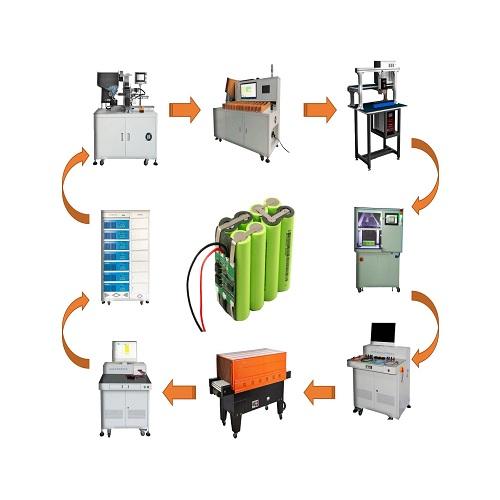
A LiFePO4 (Lithium Iron Phosphate) Cells Pack Assembly Line is specialized for manufacturing battery packs using LiFePO4 cells, which are known for their stability, long cycle life, and enhanced safety. This assembly line integrates various stages from cell inspection to final pack testing and packaging, with an emphasis on automation and quality control. Here’s a detailed look at the typical stages involved in a LiFePO4 cells pack assembly line:
Key Stages in LiFePO4 Cells Pack Assembly Line
1. Incoming Cell Inspection
Purpose: To ensure all LiFePO4 cells meet quality standards before assembly.
Process: Automated systems test each cell for capacity, internal resistance, voltage consistency, and physical integrity. Cells that do not meet specifications are rejected.
2. Cell Preparation
Cleaning: Cells undergo cleaning processes to remove contaminants that could affect performance.
Welding/Cabling: Cells are connected using precise welding techniques such as ultrasonic or laser welding to form series and parallel connections according to design specifications.
Insulation Application: Insulation materials are applied between cells and connections to prevent short circuits and ensure safety.
3. Module Assembly
Configuration: Cells are grouped into modules. Each module may incorporate cooling mechanisms like liquid cooling plates or air channels to manage heat during operation.
Connection: Electrical connections within modules are made, and protective casings are added to provide mechanical protection.
Automation: Use of robotic arms and automated machinery for handling and assembling tasks, ensuring precision and repeatability.
4. Battery Management System (BMS) Integration
Purpose: The BMS monitors and manages critical parameters such as state of charge, cell balancing, temperature, and overall health of the battery pack.
Process: Sensors and control units are integrated within the module or pack, and the BMS is programmed and calibrated to monitor and regulate the battery’s operation effectively.
5. Pack Assembly
Enclosure Design: Modules are assembled into a complete battery pack housed in a robust enclosure designed to protect against impacts, moisture, and dust.
Thermal Management Systems: Advanced thermal management solutions are integrated to maintain optimal operating temperatures.
Automation: Automated guided vehicles (AGVs) and robotic systems transport and assemble modules into the final pack configuration.
Energy Storage Battery Assembly
6. Testing and Calibration
Initial Testing: Each assembled pack undergoes rigorous testing including chargedischarge cycles, voltage checks, insulation resistance tests, and functional verification under load conditions.
Calibration: The BMS is calibrated to ensure accurate readings and proper management of the battery pack’s operation.
7. Quality Assurance and Final Inspection
Automated Inspection Systems: Visual and electrical inspections are performed using advanced technologies to check for defects and ensure compliance with quality standards.
Traceability: Documentation and serialization for traceability throughout the manufacturing process.
8. Labeling and Packaging
Labeling Machines: Automatically apply labels containing essential information such as model number, serial number, manufacturing date, and safety warnings.
Packaging Solutions: Secure packaging tailored to the specific dimensions and weight of the battery packs ensures safe transport.
Advanced Technologies and Automation
Automated Guided Vehicles (AGVs): For moving components between stations efficiently.
Robotic Arms: Perform precision tasks such as welding, handling, and assembling with high accuracy.
Machine Vision Systems: Utilized for detailed visual inspections and defect detection.
Data Analytics and AI: Monitor production efficiency, predict maintenance needs, and optimize the assembly process.
By leveraging these advanced technologies, the LiFePO4 cells pack assembly line enhances productivity, improves product quality, and ensures the safety and reliability of LiFePO4 battery packs. This structured approach allows manufacturers to produce highperformance battery packs suitable for applications ranging from electric vehicles (EVs) and renewable energy storage systems to portable electronics, making them ready for integration into enduser products.
The focus on automation and quality control ensures that every LiFePO4 battery pack leaving the assembly line meets the highest standards of performance, reliability, and safety.



 Compatible con red IPv6
 es
es en
en fr
fr de
de ru
ru pt
pt ko
ko tr
tr pl
pl th
th


